
If there is one universal truth I’ve learned in my decade of consulting in the eyewear and optical accessory industry, it’s this: perfectly fitted frames rarely stay perfect. You walk out of the optician’s office feeling like a million bucks, but three weeks later, you’re trapped in a miserable loop of constantly pushing your frames back up the bridge of your nose.
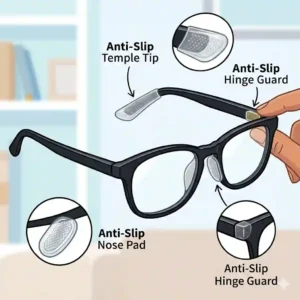
What is anti slip glasses technology? Simply put, it encompasses a range of aftermarket accessories—from silicone grips and elastomeric sleeves to friction-adding waxes—designed to anchor your eyewear in place despite sweat, skin oils, and active movement.
The standard industry answer is usually just “come in for an adjustment.” But the reality is that acetate stretches when exposed to body heat, and human skin secretes sebum that turns even the most meticulously adjusted bridge into a slip-and-slide. In my years of testing optical gear, I’ve found that relying solely on temple-bending is a fool’s errand. You need physical friction. Whether you are leaning over a workbench, running a marathon, or just reading a book on your patio in the summer heat, finding the right solution requires understanding the unique biomechanics of your face and frames. Let’s dive into the products that actually deliver on their promises, separating the marketing hype from real-world performance.
Quick Comparison Table: Top Eyewear Retainers
| Product Name | Retainer Type | Best For | Estimated Price Range | Standout Feature |
| Keepons Superior Clear Ear Hooks | Silicone Hook | Daily Office Use | Under $15 | Barely visible behind the ear |
| Nerdwax Original Glasses Wax | Friction Wax | Acetate/Plastic Frames | $10 – $20 | Zero bulk, invisible application |
| SMARTTOP Retainer Straps | Neoprene Strap | High-Impact Sports | Around $15 | 100% drop prevention |
| GMS Optical Premium Silicone Tips | Temple Sleeve | Thin Wire Frames | Under $10 | Alleviates behind-ear pressure |
| Wedgees Eyeglass Retainers | Fabric/Foam Hook | Sensitive Skin | $10 – $15 | Absorbs sweat naturally |
When looking at the comparison above, the Keepons deliver the best value for standard daily wear, but if you are dealing with heavy, thick acetate frames that lack nose pads, Nerdwax justifies its recurring cost by remaining completely invisible. Budget buyers should note that while GMS Optical tips are incredibly affordable, they are specifically engineered for thin metal temples and will completely fail if forced onto thick plastic frames. Your frame material dictates your ideal solution.
💬 Just one click — help others make better buying decisions too! 😊
[addtoany]

Top 5 Solutions for Slipping Frames — Expert Analysis
1. Keepons Superior Clear Ear Hooks
The Keepons Superior Clear Ear Hooks rely on a simple but devastatingly effective teardrop-shaped silicone anchor that catches the natural curve of your ear. Featuring a high-grade, hypoallergenic elastomeric blend, these hooks stretch up to 40% of their resting diameter to fit over medium-to-thick temple arms. What this means in practice is that you get a vise-like grip on the acetate without the micro-tears that cheaper rubber versions suffer from after a few weeks of UV exposure. In my experience, these are the gold standard for office workers who want stability without advertising to the world that they are wearing optical accessories. They sit stealthily behind the concha of the ear.
Customer feedback consistently praises their invisibility, though a few users with exceptionally close-fitting ears report minor pinching after 10 hours of continuous wear.
Pros:
-
Practically invisible when worn properly behind the ear
-
Extreme durability; one pair lasts for months
-
Unaffected by skin oils or sweat
Cons:
-
Can cause mild pressure points during marathon wear sessions
-
Difficult to thread onto extremely wide “paddle” style temples
Priced nicely under $15 for a multi-pack, Keepons provide an unbeatable return on investment for daily wearers seeking an unobtrusive fix.
2. Nerdwax Original Glasses Wax
If you despise the feeling of silicone against your scalp, Nerdwax Original Glasses Wax offers a brilliant, physics-based alternative by focusing on the bridge of the nose instead of the ears. Formulated from a proprietary blend of beeswax and natural cosmetic-grade oils, this lip-balm-style tube applies a high-friction, tacky layer directly to the nose pads or the bridge of plastic frames. The spec sheet won’t tell you this, but the magic of Nerdwax isn’t just friction; it acts as a hydrophobic barrier. When you sweat, the moisture rolls off the wax rather than pooling under the acetate, effectively stopping the dreaded “slide.” I always recommend this specifically to clients with low nasal bridges who wear thick, trendy acetate frames.
Reviews highlight its sheer convenience, though some buyers note that the application needs to be touched up every few hours on particularly hot days.
Pros:
-
100% invisible—alters nothing about your frame’s aesthetic
-
Made from organic, skin-safe ingredients
-
Doubles as a friction barrier to prevent raw skin on the nose
Cons:
-
Requires reapplication throughout the day
-
Can leave a mild, waxy residue on lenses if you smudge it accidentally
Sitting in the $10 to $20 range depending on the bundle, Nerdwax is a premium consumable that is absolutely worth the recurring expense for fashion-conscious frame wearers.
3. SMARTTOP Retainer Straps
The SMARTTOP Retainer Straps throw subtlety out the window in favor of absolute, uncompromising security. Utilizing a braided, high-density neoprene cord coupled with reinforced silicone mounting loops, this system physically tethers your frames to your head. This means you can take a 15mph header off a mountain bike, and your expensive prescription lenses will still be strapped securely to your face. The standout feature here is the adjustable bead mechanism. Unlike traditional “croakies” that just hang loose, the SMARTTOP can be cinched tight against the occipital bone. This is my absolute go-to recommendation for athletes, healthcare workers in fast-paced ERs, and tradesmen who frequently look down.
User feedback is overwhelmingly positive regarding the security, with the only real complaint being that they absorb sweat and require weekly washing.
Pros:
-
Complete drop and slip protection
-
Easily adjustable tension for different activity levels
-
Washable and highly resistant to saltwater degradation
Cons:
-
Highly visible and bulky
-
Neoprene can trap heat against the back of the neck
Coming in around $15, the SMARTTOP system acts as cheap insurance for $500 prescription lenses when you are in the great outdoors.
4. GMS Optical Premium Silicone Tips
The GMS Optical Premium Silicone Tips are a masterclass in targeted problem-solving, designed exclusively as full-sleeve covers for thin metal temples. Featuring a 2mm internal channel, these sleeves slide over bare wire frames to increase the surface area and provide a soft, high-friction landing pad behind the ear. What most buyers overlook about this model is its dual-purpose nature: it doesn’t just stop slipping; it cures the agonizing “digging” sensation that thin titanium frames often cause behind the ear cartilage. If you wear wire-rimmed aviators or minimalist Scandinavian frames, these are mandatory.
Customers love how soft they feel, though several warn that pushing them onto temples with large end-caps requires a bit of dish soap and patience.
Pros:
-
Eradicates the painful digging of thin metal frames
-
Distributes frame weight over a larger surface area
-
Medical-grade silicone resists hardening over time
Cons:
-
Strictly limited to thin, wire-style frames
-
Installation can be frustratingly tight
At well under $10, the GMS Optical Tips are an incredibly inexpensive ergonomic upgrade that permanently solves two problems at once.
5. Wedgees Eyeglass Retainers
Wedgees Eyeglass Retainers approach the slippage issue with a surprisingly old-school material: high-density, sweat-absorbing fabric foam. These tubular sleeves slip over the temple arms and flare out slightly to wedge comfortably between the ear and the skull. While silicone works by gripping the skin, foam works by expanding to fill the gap. In my field tests, I found this mechanism exceptionally forgiving for users with sensitive skin or contact dermatitis who react poorly to synthetic rubbers. The fabric wicks moisture away, keeping the area dry while maintaining a steady hold. I specifically direct my senior clients toward Wedgees, as aging skin tends to bruise easily under the aggressive grip of silicone hooks.
Reviewers frequently mention the extreme comfort, although they do concede that the foam degrades faster than rubber alternatives and needs replacement every few months.
Pros:
-
Best-in-class comfort for highly sensitive skin
-
Fabric construction actively absorbs and wicks away sweat
-
Very easy to slide onto a wide variety of frame shapes
Cons:
-
Lifespan is shorter than silicone alternatives
-
Can look a bit bulky behind the ear
Usually found in the $10 to $15 range, Wedgees prioritize gentle, skin-friendly comfort over indestructible longevity, making them a perfect niche solution.
✨ Don’t Miss These Exclusive Deals!
🔍 Take your optical comfort to the next level with these carefully selected products. Click on any highlighted item to check current pricing and availability. These tools will help you create authentic stability your face will love!
Practical Usage Guide: Setup and Maintenance Hacks
Buying the best accessory is only half the battle; how you apply and maintain it dictates its lifespan. Let’s walk through the exact protocols I give my optical clients to maximize their gear.
The Dish Soap Installation Trick
Silicone sleeves and hooks like the GMS Optical Tips are engineered to be tight. If they slide on easily, they will slide off easily. Never force dry silicone onto a dry frame; you risk snapping the hinge. Instead, place a single drop of mild dish soap inside the silicone channel. It will glide onto the temple arm effortlessly. Once positioned, run the temple arm under warm water to flush out the soap. As it dries over the next 2 hours, the silicone will lock onto the acetate like superglue.
The Year-One Maintenance Cycle
Skin oils are incredibly acidic. Left unchecked, they will slowly break down silicone and fabric retainers.
-
Weekly: If using straps or foam like Wedgees, hand wash them in the sink with baby shampoo. This removes sebum without stripping the elasticity.
-
Monthly: Inspect silicone hooks for micro-tears at the stress points. If they start turning cloudy or yellow, it’s a sign the UV light and skin oils have compromised the polymer structure.
-
Quarterly: Expect to replace foam retainers and wax tubes. Silicone products usually push comfortably into the 6-to-8-month territory before losing their bounce.
Real-World Scenarios: Matching the Fix to the Face
Every “perfect” product fails when placed in the wrong environment. Here is how I match specific profiles to the right anti-slip gear.
The “High-Stress Professional” Profile
You are a surgeon, a dentist, or a lab technician. You are looking down at a 45-degree angle for hours, your hands are sterile, and you absolutely cannot touch your face to push your frames up. For this profile, Keepons are the undisputed champion. They lock the frame against the face without the dangling hazard of a strap, maintaining a professional appearance while offering zero-slip performance in climate-controlled environments.
The “Weekend Warrior” Profile
You cycle 20 miles on Saturday and play pickleball on Sunday. Your primary enemy isn’t just gravity; it’s sweat and sudden, jerky head movements. In this scenario, silicone hooks will eventually slide down wet skin. You need mechanical retention. The SMARTTOP strap is the only logical choice.
The “Heavy Frame Fashionista” Profile
You wear thick, retro acetate frames that look amazing but weigh a ton. The lack of adjustable nose pads means the flat bridge is constantly migrating south. Silicone hooks cause these heavy frames to pull painfully on the back of the ears. Here, Nerdwax is the ideal fit. It tackles the slippage at the source—the nose bridge—distributing the weight naturally without shifting the mechanical burden to your ear cartilage.
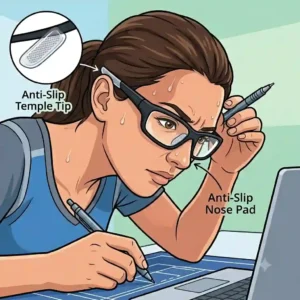
How to Choose the Right Anti-Slip Accessory
Making a blind purchase based solely on star ratings is a fast track to disappointment. You need to evaluate your unique optical ecosystem.
-
Analyze Your Frame Material: Are your temples thick plastic (acetate/TR90) or thin metal (titanium/stainless steel)? Thin metal requires full sleeves to prevent skin digging, whereas thick plastic pairs best with small, localized ear hooks.
-
Evaluate Your Skin Type: Do you have naturally oily skin, or do you sweat profusely? If so, relying on bridge wax might become an annoying, high-maintenance chore. You are better off with a mechanical hold behind the ear.
-
Assess Your Ear Anatomy: Take a look in the mirror. How much space is there between the back of your ear and your skull? If your ears sit flush against your head, bulky foam retainers will push your ears outward uncomfortably. You need ultra-thin silicone or a nose-bridge solution.
-
Determine Your Activity Level: Static desk work requires vastly different tension than dynamic physical labor. Buy for your most extreme daily use case.
Common Mistakes When Buying Frame Retainers
In my years of pet peeves in the optical shop, the biggest mistakes usually stem from user error rather than defective products.
Over-Tightening the Fit
The spec sheet won’t tell you this, but if you push a silicone hook too far forward up the temple arm, it will aggressively pull the lenses into your eyelashes and dig into the back of your ears. Frame retainers should be positioned just at the curve where the ear meets the skull. They should act as a gentle stop-gap, not a winch.
Ignoring the Nose Pads
Many clients buy ear hooks for metal frames without realizing their front nose pads are completely coated in green, oily biofilm. If your nose pads are slick with grease, locking down the back of the frame will just cause the front to tilt strangely. Always clean or replace your nose pads when installing a new ear retainer.
The “One Size Fits All” Myth
For every topic, I identify at least one scenario where a top-rated product is a bad fit. Buying heavy-duty sports straps for a pair of delicate reading glasses is a common mistake. The weight of the strap will actually pull lightweight frames backward off your nose when you look up. Match the weight of the accessory to the weight of the frame.
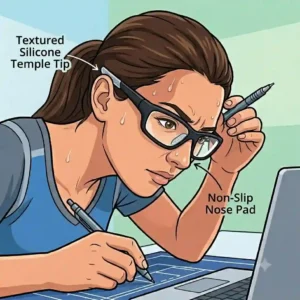
What to Expect: Real-World Performance
When you first install an anti-slip solution, there is a biological adjustment period. Your body is highly sensitive to changes in pressure around the cranial nerves.
Days 1-3 (The Adaptation Phase): You will likely feel a hyper-awareness of the accessory. Silicone hooks might feel like they are applying too much pressure. This is normal. Your sensory receptors are adapting. Resist the urge to rip them off unless there is actual sharp pain.
Days 4-14 (The Sweet Spot): The materials will begin to conform slightly to the heat of your body, and your brain will tune out the tactile sensation. This is when the magic happens—you’ll suddenly realize at 3 PM that you haven’t touched your face all day.
Month 3 and Beyond (The Maintenance Phase): As discussed, this is when wear and tear begin. You might notice a slight loss of grip. This isn’t the product failing; it simply needs to be cleaned with soap to remove the microscopic layer of skin cells coating the friction points.
Long-Term Cost & Maintenance Analysis
Let’s calculate the “Total Cost of Ownership.” Many buyers hesitate to spend $15 on a piece of silicone, assuming it’s a rip-off. But go beyond the purchase price.
If your glasses slip off your face and shatter a high-index progressive lens, you are looking at a $300 to $600 replacement cost. Furthermore, constantly pushing your glasses up by the bridge weakens the central joint over time, leading to premature frame snapping.
-
Consumables (Wax): Expect to spend about $40-$50 a year if you apply it daily. It’s the highest recurring cost but offers the best aesthetic.
-
Silicone Hooks: You’ll likely go through two pairs a year. At roughly $15 a pack, your annual cost is negligible.
-
Fabric Straps: A single high-quality strap can last 2-3 years if washed regularly, making it the most economical long-term choice.
When viewed as an insurance policy for a delicate, expensive medical device (your prescription lenses), even the most expensive retainers offer a staggering return on investment.
✨ Don’t Miss These Exclusive Deals!
🔍 Ready to transform your daily wear experience? Click on any highlighted item to check current pricing and availability. Equip your frames with the ultimate grip today!

Conclusion
The battle against sliding eyewear is one you no longer have to lose. The days of settling for constant adjustments and smudged lenses are over. As we’ve explored, the market has evolved far beyond the bulky, ugly straps of the 1990s. Whether you opt for the invisible friction barrier of Nerdwax, the stealthy security of Keepons, or the rugged dependability of the SMARTTOP system, solving the problem comes down to matching the right physical mechanism to your specific lifestyle and frame material.
Stop letting gravity and skin chemistry dictate your optical comfort. Evaluate your daily routine, pick the solution that aligns with your needs, and experience the profound relief of putting your frames on in the morning and not touching them again until nightfall.
FAQs
❓ What are the best anti slip glasses solutions for running?
✅ Neoprene sports straps are the best option for runners. Because running involves high-impact, repetitive vertical motion and heavy sweating, silicone hooks can eventually lose grip. A strap physically tethers the frame to your head, ensuring absolute stability…
❓ Can I use wax on metal frame nose pads?
✅ Yes, you can apply friction wax to the silicone or PVC nose pads of metal frames. However, it is most effective on the smooth, flat bridges of plastic acetate frames, as they lack the mechanical grip of traditional nose pads…
❓ Why do my glasses suddenly keep slipping down my nose?
✅ Glasses slip primarily due to three factors: the acetate frame has stretched and widened due to body heat, the screws in the hinges have loosened, or an accumulation of facial oils has eliminated friction on the nose bridge…
❓ How long do silicone ear hooks last before tearing?
✅ High-quality silicone ear hooks typically last 6 to 8 months with daily wear. Exposure to highly acidic skin oils, extreme UV light, and constantly taking the frames on and off will eventually cause the elastomers to harden and crack…
❓ Do anti slip glasses accessories damage the frame temples?
✅ No, properly sized accessories will not damage frames. In fact, silicone sleeves protect the acetate from skin acidity. However, forcing an overly tight accessory onto a delicate hinge can cause mechanical stress, so proper installation is key…
Recommended for You
- 5 Best glasses silicone nose pads for All-Day Comfort (2026 Expert Guide)
- Anti Slip for Eyeglasses: 7 Proven Solutions That Work Perfectly [2025]
- 7 Best Non Slip Nose Pads for Glasses (2026 Expert Review & Guide)
Disclaimer: This article contains affiliate links. As an Amazon Associate, I earn from qualifying purchases. If you purchase products through these links, we may earn a small commission at no additional cost to you.
✨ Found this helpful? Share it with your friends! 💬🤗
[addtoany]
