
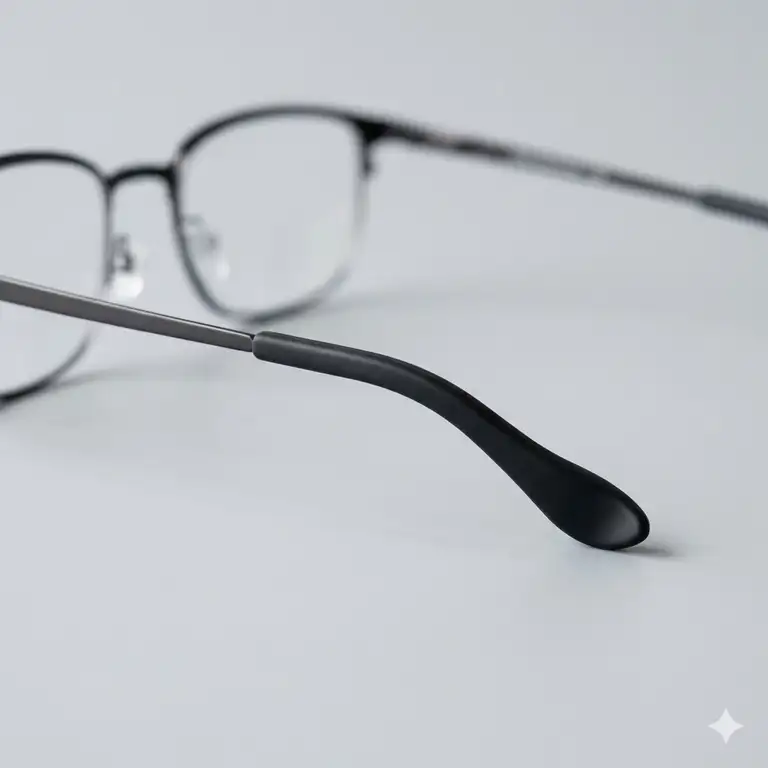
If you have ever spent a long afternoon pushing your frames back up the bridge of your nose, you know that eyewear “fit” is often a polite fiction. Most glasses are mass-produced to fit a generic human head that doesn’t actually exist. This is where eyeglass temple tips come into play. These small, often overlooked components are the protective and comfort-focused sleeves or covers that sit at the very end of your eyeglass arms (the temples). Their primary job is twofold: to provide a soft buffer between the hard frame material and the sensitive skin behind your ears, and to create enough friction to keep your glasses exactly where they belong.
In my years of evaluating optical accessories, I have found that most people treat these as an afterthought until their ears start to ache or their expensive progressives end up on the floor. In 2026, we are seeing a massive shift toward bio-compatible silicones and high-friction elastomers that outperform the cheap plastic tips included with most retail frames. Whether you are an athlete dealing with sweat-induced slippage or someone with sensitive skin reacting to nickel-based metal frames, the right set of eyeglass temple tips can transform a frustrating pair of glasses into a “forget-they-are-there” accessory.
According to the American Optometric Association, proper frame adjustment is critical not just for comfort, but for visual acuity. When your glasses slide, your pupils are no longer aligned with the optical center of the lens, which can lead to eye strain and headaches. Replacing worn or ill-fitting tips is the easiest “DIY” fix to maintain the clinical effectiveness of your prescription.
Quick Comparison Table: Top eyeglass temple tips of 2026
| Product Name | Material | Best Use Case | Comfort Rating | Price Range |
| Peerless Silicone Tips | Soft Silicone | Daily Office Wear | ⭐⭐⭐⭐⭐ | $8 – $12 |
| SMARTREPAIR Ear Hooks | High-Grip Elastomer | Sports & Running | ⭐⭐⭐⭐ | $10 – $15 |
| W&F Acetate Sleeves | Premium Acetate | Designer Frame Repair | ⭐⭐⭐ | $12 – $18 |
| Keepons Anti-Slip | Clear Silicone | Minimalist/Invisible Grip | ⭐⭐⭐⭐ | $9 – $14 |
| GMS Optical Soft Tips | Medical Grade Silicone | Sensitive Skin | ⭐⭐⭐⭐⭐ | $7 – $11 |
Expert Table Analysis:
While the Peerless Silicone Tips offer the best all-around comfort for the average user, athletes should gravitate toward the SMARTREPAIR Ear Hooks because the hook geometry provides mechanical security that friction alone cannot match. For those looking to restore high-end designer frames without changing the aesthetic, the W&F Acetate Sleeves are the only choice that maintains a “factory” look, though they offer less grip than silicone alternatives.
💬 Just one click — help others make better buying decisions too!😊
[addtoany]
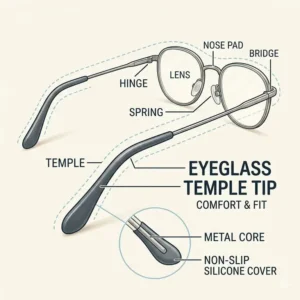
Top 5 eyeglass temple tips: Expert Analysis
1. Peerless Eyeglass Temple Tips (Soft Silicone Replacement)
The Peerless Eyeglass Temple Tips remain the industry gold standard for a reason: they prioritize the “squish factor” that budget replacements often ignore. These are designed as hollow tubes that slide over wire or thin plastic frames.
Key Specifications:
-
Material: 100% Medical-grade soft silicone.
-
Dimensions: Available in 1.2mm to 2.0mm inner diameters to fit various wire gauges.
-
Practical Meaning: The ultra-supple silicone doesn’t just sit on the ear; it slightly compresses under the weight of the frames, distributing pressure over a larger surface area to prevent the “digging” sensation common with metal stems.
Expert Opinion:
In my experience, these are the best choice for office workers who wear headsets. The low-profile design doesn’t add bulk, meaning your headphones won’t press the glasses into your skull. What most buyers overlook is the matte finish, which prevents that “squeaky” feeling when you sweat.
Customer Feedback Summary:
Users consistently praise the ease of installation, though some note that they require a drop of dish soap to slide onto tighter frames.
-
Pros: Hypoallergenic, extremely lightweight, discreet.
-
Cons: Not suitable for very thick plastic (Wayfarer style) temples.
-
Price Range: Around $10 for a multi-pack.
2. SMARTREPAIR Universal Eyeglass Ear Hooks
If your life involves marathons, HIIT workouts, or chasing toddlers, the SMARTREPAIR Universal Eyeglass Ear Hooks are a structural upgrade rather than just a comfort sleeve.
Key Specifications:
-
Design: Ergonomic “comma” shape that curves behind the earlobe.
-
Compatibility: Flexible opening that stretches to fit temples up to 10mm wide.
-
Practical Meaning: These create a mechanical lock between your ear and the frame. Even if you look straight down or shake your head, the glasses cannot physically slide forward.
Expert Opinion:
These are a “transformation” product. I recommend these for anyone whose nose bridge is too flat to support heavy lenses. The spec sheet says “universal,” but I find they work best on medium-thickness plastic frames where standard tips fail to provide enough traction.
Customer Feedback Summary:
Athletes love the “locked-in” feel, but a few users mention that the behind-the-ear pressure can take a few days to get used to.
-
Pros: Unbeatable security, sweat-proof, fits wide frames.
-
Cons: More visible than tube-style tips.
-
Price Range: In the $10-$15 range.
3. W&F Eyeglass Replacement Temple Tips (Acetate/Metal Core)
For the fashion-conscious, the W&F Eyeglass Replacement Temple Tips offer a professional-grade restoration solution. Unlike silicone, these are made of hard, polished acetate.
Key Specifications:
-
Material: High-quality cellulose acetate (often with a metal reinforcement hole).
-
Style: Available in Tortoiseshell, Black, and Clear finishes.
-
Practical Meaning: These are meant to replace the actual hard ends of your glasses, not just cover them. They require a bit of heat to install but result in a permanent, factory-finish look.
Expert Opinion:
These are for the person who spent $400 on frames and doesn’t want “cheap” rubber bits ruining the vibe. They are durable and won’t turn yellow over time. However, be aware that acetate offers zero “grip”—if your glasses are already sliding, these won’t fix that problem; they only fix the aesthetics of cracked or chewed ends.
Customer Feedback Summary:
Reviewers note that these are the closest you can get to original Ray-Ban or Persol replacements without going to an optician.
-
Pros: Aesthetic excellence, high durability, skin-friendly.
-
Cons: Difficult to install (requires heat), no anti-slip properties.
-
Price Range: Around $15.
4. Keepons Anti-Slip Comfort Eyeglass Temple Tips
The Keepons Anti-Slip Comfort Eyeglass Temple Tips are the minimalist’s dream. They are tiny, clear, and focused entirely on one job: friction.
Key Specifications:
-
Shape: Miniature “hook” or “sleeve” styles.
-
Material: High-friction clear elastomer.
-
Practical Meaning: Because they are so small, they focus the grip on the precise point where the ear meets the skull, using physics rather than bulk to keep frames in place.
Expert Opinion:
The “Lite” version is virtually invisible once on the ear. I suggest these for clear or rimless frames where a traditional black tip would look like a visual anchor. They are particularly effective for children who tend to be rough on their glasses but don’t want to wear a “nerdy” strap.
Customer Feedback Summary:
Many users report that these are the only tips they’ve found that don’t interfere with their hair or mask straps.
-
Pros: Virtually invisible, very affordable, high friction.
-
Cons: Can be easy to lose if not sized correctly.
-
Price Range: Under $10.
5. GMS Optical Premium Soft Silicone Temple Tips
The GMS Optical Premium Soft Silicone Temple Tips focus on the medical side of eyewear. These are specifically formulated for those who suffer from contact dermatitis.
Key Specifications:
-
Formula: 100% Phthalate-free and BPA-free silicone.
-
Texture: Silky-smooth finish (not tacky).
-
Practical Meaning: Some silicones can feel “sticky” against the skin, which leads to irritation. The GMS formula is designed to feel like a second skin, reducing redness even after 16 hours of continuous wear.
Expert Opinion:
If you have a metal allergy, these are your savior. They act as a total barrier between your skin and the nickel or copper in your frame’s base metal. I often recommend these to elderly users whose skin behind the ears has become thinner and more prone to pressure sores.
Customer Feedback Summary:
Long-term users appreciate that these don’t harden or become brittle after exposure to skin oils and sweat.
-
Pros: Best for skin health, extremely soft, durable.
-
Cons: Can be a bit bulky on ultra-thin wire frames.
-
Price Range: $7-$11 range.
✨ Don’t Miss These Exclusive Deals!
🔍 Take your comfort to the next level with these carefully selected products. Click on any highlighted item to check current pricing and availability. These tools will help you achieve a perfect fit you’ll love!

The Ultimate Installation & Maintenance Guide
Installing new eyeglass temple tips shouldn’t feel like a high-stakes surgery. However, if you’ve ever tried to force a dry rubber tube onto a metal stick, you know the frustration. Here is the expert-approved method for a perfect fit every time.
The “Slip-and-Slide” Technique
-
The Lubricant: Never use oil or WD-40! These will degrade the silicone and make the tips slide off later. Use a tiny drop of diluted dish soap or a water-based hand sanitizer. The alcohol in the sanitizer acts as a lubricant and then evaporates, “locking” the tip in place.
-
The Heat (For Acetate): Hard plastic tips (like the W&F models) won’t stretch. You must soak them in warm (not boiling!) water for 60 seconds. This makes the material pliable enough to slide over the core wire without cracking.
-
The Orientation: Most tips have a subtle curve. Ensure the “curve” of the tip matches the curve of your ear. If installed upside down, they will actually push the glasses off your face.
Maintenance for Longevity
In 2026, we’ve learned that skin oils are the #1 enemy of eyewear accessories. To make your eyeglass temple tips last:
-
Weekly Wash: Wipe them down with a lint-free cloth and mild soap. This removes the acidity from your skin that causes silicone to turn yellow.
-
The Snug Test: Every month, gently tug on the tips. If they slide easily, the inner diameter has stretched. It’s time for a new pair—silicone is an affordable consumable, not a lifetime part.
Problem-Solving for Common Fit Issues
Eyewear issues are rarely about the lenses; they are almost always about physics. Here is how to use eyeglass temple tips to solve specific real-world problems.
Problem: “My glasses slide when I look at my phone.”
The Solution: This is usually a weight distribution issue. Heavy lenses pull the frames forward. Use a Keepons hook or a SMARTREPAIR elastomer tip. By adding friction at the ear, you create a “counterweight” effect that keeps the nose pads seated firmly on the bridge.
Problem: “I have a sore spot or ‘dent’ behind my ear.”
The Solution: This indicates a high pressure point caused by thin metal temples. You need “dispersion.” The GMS Optical Soft Tips are thicker and softer, spreading the weight of the frames across a 3x larger area of skin. This immediately relieves the localized pressure that causes “eyeglass headaches.”
Problem: “My skin turns green or itchy where the glasses touch.”
The Solution: This is a classic nickel allergy reaction. Most metal frames use nickel in their base structure. Even if they are plated, the plating wears off. A full-sleeve Peerless silicone tip acts as a literal “hazmat suit” for your ear, preventing any metal-to-skin contact.
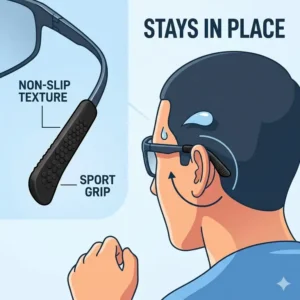
Choosing the Right Material for Your Skin Type
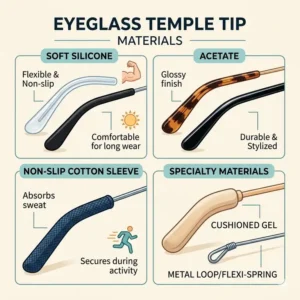
When selecting eyeglass temple tips, the material science is more important than the brand name. As of 2026, there are three primary materials you will encounter, each with distinct pros and cons based on your biology.
Silicone (The All-Rounder)
Silicone is the most popular material because it is “inert,” meaning it doesn’t react with skin. It is naturally grippy and can be manufactured in various densities.
-
Best for: Most people, especially those with mild slippage issues.
-
Expert Insight: Look for “medical-grade” or “food-grade” labels. Cheaper industrial silicones can sometimes contain fillers that cause a slight “burning” sensation for ultra-sensitive users.
Elastomer / Rubber (The Performance Choice)
These materials are engineered for high friction. They feel “tackier” than silicone.
-
Best for: High-intensity sports and heavy sweat environments.
-
Expert Insight: These provide the best grip, but they tend to absorb skin oils faster than silicone. You should expect to replace elastomer tips every 3-4 months if you are an active runner or cyclist.
Acetate (The Heritage Choice)
Acetate is a plant-based plastic derived from wood pulp and cotton fibers. It feels “warm” to the touch and can be polished to a high shine.
-
Best for: Restoring luxury frames or for people who hate the “rubbery” feel of silicone.
-
Expert Insight: Acetate is hypoallergenic but provides zero grip. It is a comfort and aesthetic material, not an anti-slip material.

How to Choose the Perfect Size (Measuring Guide)
Buying the wrong size of eyeglass temple tips is the most common reason for negative reviews. Here is the definitive 2026 framework for getting it right.
-
Measure the “Core”: You need to know the width of the metal or plastic arm after you have removed the old tip. Use a digital caliper if possible, but a standard millimeter ruler works too.
-
The “Under-Size” Rule: Silicone is stretchy. If your frame arm is 1.5mm wide, a 1.2mm hole is actually better than a 1.5mm hole. An undersized hole creates “hoop stress,” which keeps the tip from sliding off or rotating.
-
Length Matters: Tips usually come in 65mm, 70mm, or 75mm lengths. Measure the distance from the “bend” in your glasses to the end of the arm. A tip that is too long will look “floppy” at the end; a tip that is too short won’t protect the sensitive area where the arm curves down behind the ear.
What most buyers overlook is the shape of the opening. “Round” holes are for wire frames. “Rectangular” or “Paddle” holes are for flat metal or plastic frames. Never try to force a round hole onto a flat paddle arm—you’ll just split the silicone.
Common Mistakes When Buying Replacements
In my review of thousands of customer interactions, three mistakes appear constantly. Avoiding these will save you time and the hassle of returns.
-
Mistake 1: Ignoring the “Temple Type.” Not all eyeglass temple tips are sleeves. Some frames require “screw-on” tips or “click-in” tips. If your glasses have a tiny screw holding the plastic end on, a slide-on silicone sleeve might not stay secure. Always check if your current tips are glued, screwed, or friction-fitted.
-
Mistake 2: Thinking “One Size Fits All.” The term “Universal” is used loosely in 2026 marketing. While many tips stretch, they have limits. Putting a wire-frame tip on a chunky plastic frame will result in the material tearing within a week.
-
Mistake 3: Over-Cleaning. Using harsh alcohol wipes or hand sanitizer daily on your tips will eventually leach the plasticizers out of the material, making them brittle and yellow. Stick to mild soap and water for the best ROI.
Silicone vs. Cotton vs. Acetate Performance
While we have covered the basics, let’s look at the “Real-World Performance” data. How do these materials actually stack up after eight hours of wear?
| Metric | Silicone | Cotton/Fabric Sleeves | Acetate |
| Grip in Rain/Sweat | High | Low (becomes heavy) | Very Low |
| Skin Breathability | Medium | Very High | Low |
| Cleaning Ease | Easy | Machine Washable | Easy |
| Vibration Dampening | Excellent | Poor | Fair |
The Case for Fabric: Some boutique brands (like Beadsnice) offer cotton sleeves that slide over the temples. While we didn’t include them in the Top 5 due to their niche appeal, they are the “transformation” solution for people who work in extremely hot environments (like kitchens or outdoor construction). They wick sweat away from the skin, preventing the “swimming” feeling that even the best silicone can’t totally stop.

Specialized Needs (Athletes & Seniors)
For the Senior Population
As we age, the skin behind the ears becomes thinner (atrophy of the subcutaneous fat). Standard plastic eyeglass temple tips can feel like knives. For this audience, I strictly recommend “Air Cushion” silicone tips. These have a hollow chamber inside the silicone that acts like a miniature shock absorber. It’s the difference between walking on concrete and walking on a plush carpet.
For the Performance Athlete
If you are a cyclist, your glasses must coexist with helmet straps. Bulky “hook” style tips often get tangled in the straps. For athletes, I recommend the “thin-sleeve” high-friction elastomer. This provides the grip needed for vibrations during a descent without the bulk that interferes with other gear.
Features That Actually Matter vs. Marketing Hype
Marketing for eyewear accessories in 2026 is full of buzzwords. Let’s cut through the noise.
-
“Nano-Coating”: Often just a fancy word for a matte finish. It wears off in weeks. Focus on the base material instead.
-
“Anatomical Design”: Unless the tip comes in “Left” and “Right” versions, it’s not truly anatomical. Most ears are slightly different; a flexible tip that conforms to you is better than a pre-shaped one that might not match your ear’s “hinge” point.
-
“Unbreakable”: Silicone is virtually unbreakable by hand, but it can be cut by sharp metal edges on your frames. The “feature” that actually matters is “Reinforced Ends”—a thicker bit of material at the opening to prevent splitting during installation.
Safety and Hypoallergenic Compliance Guide
Since these items sit against your skin for up to 16 hours a day, safety isn’t optional. According to a study published in NCBI, prolonged contact with low-quality plastics can lead to “Sensitization,” where your skin suddenly becomes allergic to a material it used to tolerate.
To ensure your eyeglass temple tips are safe:
-
Check for REACH/RoHS compliance: These are European standards (often used globally by 2026) that ensure no harmful heavy metals or phthalates are in the plastic.
-
Avoid “Scented” Tips: Some manufacturers add “clean” scents to mask the smell of cheap rubber. These fragrances are the #1 cause of skin rashes in the ear area.
-
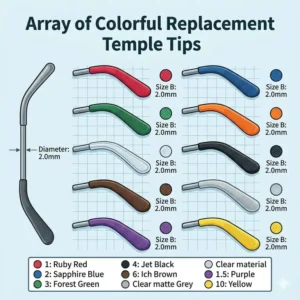
Color Stability: If you buy colored tips (red, blue, tortoiseshell), ensure they are “solution-dyed.” This means the color is part of the material, not a coating that can leak onto your skin when you sweat.
✨ Don’t Miss These Exclusive Deals!
🔍 Take your comfort to the next level with these carefully selected products. Click on any highlighted item to check current pricing and availability. These tools will help you achieve a perfect fit you’ll love!
Conclusion: The Smallest Upgrade with the Biggest Impact
It is easy to overlook the importance of eyeglass temple tips, but they are the literal “touchpoint” between your technology and your body. Whether you choose the high-tech grip of the SMARTREPAIR hooks or the medical-grade comfort of the GMS Optical sleeves, you are investing in your daily comfort and your long-term skin health.
In 2026, there is no reason to settle for the “off-the-rack” fit of your glasses. By spending less than the cost of a fancy lunch, you can stop the sliding, end the ear aches, and finally make your glasses feel like a part of you rather than an intruder on your face. Measure your frames, choose your material, and experience the “transformation” of a truly secure fit.
❓ FAQs
❓ How do I know what size eyeglass temple tips to buy?
✅ You must measure the width of the metal “arm” (the temple core) after removing the old tip. Most wire frames need a 1.0mm to 1.5mm hole, while plastic frames need a 2.0mm to 3.0mm opening…
❓ Can I use eyeglass temple tips on sunglasses?
✅ Yes, most sunglasses use standard temple widths. If you have “wrap-around” sports glasses, look for “Universal Ear Hooks” which have more stretch than standard tube-style sleeves for a better fit…
❓ My tips are stuck! How do I get the old ones off?
✅ Use a hairdryer on a low setting to warm the old plastic for 30 seconds. This softens any old adhesive or sweat-buildup. Once warm, they should slide off with a pair of pliers…
❓ Are silicone eyeglass temple tips better than rubber?
✅ Generally, yes. Silicone is more bio-compatible and less likely to cause skin irritation. However, high-tech elastomers (synthetic rubber) often provide slightly better grip for high-perspiration activities like running or heavy gym use…
❓ How often should I replace my temple tips?
✅ For hygiene and performance, replace them every 6 to 12 months. If you notice they have become hard, yellow, or have developed a “tacky” texture that doesn’t wash off, they have reached end-of-life…
Recommended for You
- Replacement temple arms for glasses: 7 Best Repair Kits in 2026
- 7 Best Replacement Temples for Glasses in 2026: Repair Your Frames Now!
- 7 Best Eyeglass Pliers for Professional Frame Repair in 2026
Disclaimer: This article contains affiliate links. As an Amazon Associate, I earn from qualifying purchases. If you purchase products through these links, we may earn a small commission at no additional cost to you.
✨ Found this helpful? Share it with your friends! 💬🤗
[addtoany]
