
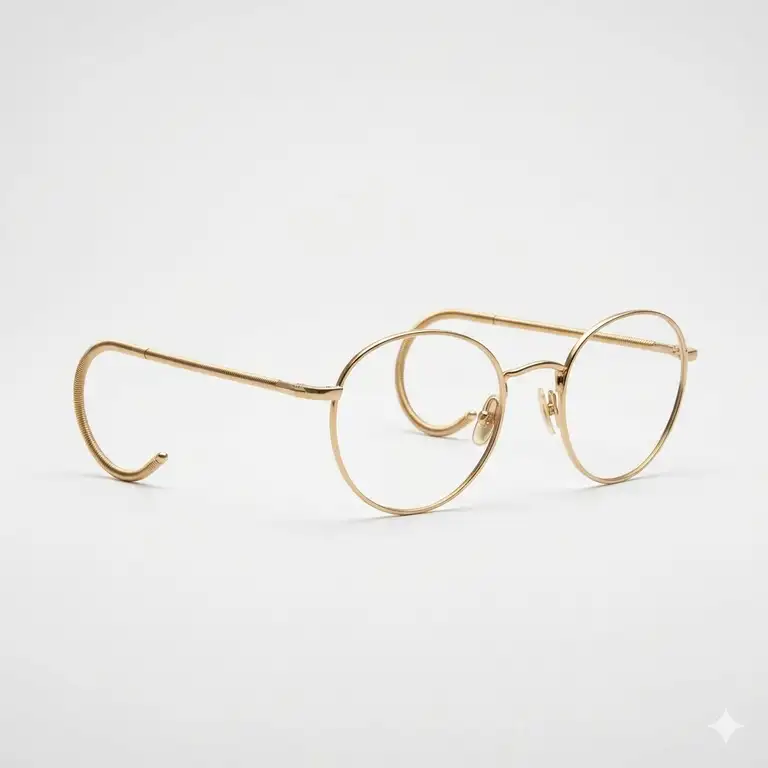
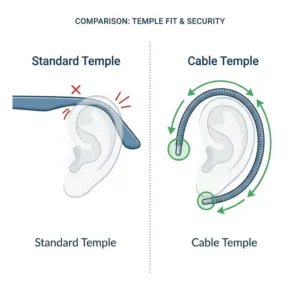
If you have ever leaned over to tie your shoes only to have your spectacles dive-bomb onto the pavement, you’ve likely felt the frustration that standard eyewear can cause. This is where cable temple eyeglass frames come to the rescue. Unlike traditional “skull temples” that simply rest atop the ear, cable temples—often called “riding temples” or “curl temples”—feature a flexible, curved extension that wraps almost entirely around the back of the ear. Originally designed for horse riders and military personnel in the early 20th century, these frames provide a level of security that modern paddle temples simply cannot match.
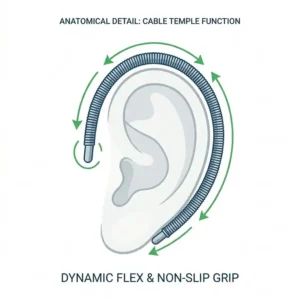
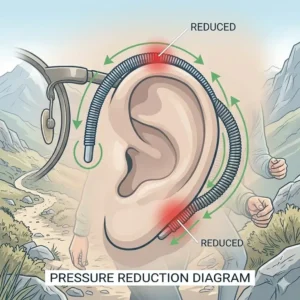
In 2026, the technology behind these frames has evolved significantly. We are no longer limited to the rigid, sometimes painful metal coils of the past. Today’s cable temple eyeglass frames utilize high-tensile memory metals, soft silicone overlays, and ergonomic tapering to ensure that your glasses stay put during high-intensity sports, heavy labor, or even just a busy day chasing toddlers. By distributing the weight of the frame more evenly around the ear’s cartilage, they alleviate pressure on the nose bridge—a godsend for those with high-prescription, heavy glass lenses.
According to Wikipedia’s history of eyewear, the development of the “wraparound” style was a pivotal moment in optical engineering, transitioning glasses from handheld “lorgnettes” to truly wearable tools. Whether you are a vintage enthusiast looking for that classic 1930s aesthetic or an athlete needing “no-slip” reliability, cable temples remain the gold standard for optical stability.
Quick Comparison: Top Cable Temple Styles
| Frame Style | Best For | Material | Flexibility Level | Security Rating |
| Classic Metal Rounds | Vintage Enthusiasts | Monel/Stainless Steel | Medium | 9/10 |
| Aviation / Outdoors | Active Lifestyles | High-Grade Titanium | High | 10/10 |
| Children’s Cables | Kids & Toddlers | Silicone-Coated Bio-plastic | Extreme | 10/10 |
| Modern Professional | Office & Light Activity | Acetate with Cable Tips | Low-Medium | 7/10 |
| Safety Rated | Industrial Work | Impact-Resistant Polymer | Medium | 9/10 |
Expert Analysis of Comparison Data:
The table above highlights that security and flexibility are often linked; children’s frames and athletic aviation models prioritize a “hugging” fit that won’t budge. However, if you are looking for an everyday office look, the modern acetate hybrids provide a balanced 7/10 security without looking like you’re about to jump out of a plane. For those working in high-motion environments, the 10/10 rating of the aviation styles is non-negotiable for safety.
💬 Just one click — help others make better buying decisions too!😊
[addtoany]
Top 5 Cable Temple Eyeglass Frames: Expert Analysis
Choosing the right cable temple eyeglass frames requires looking past the aesthetic and into the metallurgy and ergonomics of the “curl.” Here is our curated list for 2026.
1. Savile Row Beaufort Panto with Comfort Cable
The Savile Row Beaufort is the quintessential example of heritage eyewear, handmade in London using traditional 18kt rolled gold. While many brands attempt the “vintage look,” this frame is the vintage standard.
The Beaufort features a 145mm to 165mm cable length option, which is critical. In my experience, the biggest mistake people make with Savile Row is ordering a cable that is too short, leading to “ear pinch.” Because these are rolled gold over a core of nickel silver, the cable has a “memory” that stays exactly where you bend it. This isn’t a “one size fits all” flex-metal; it’s a custom-fit experience. If you are a fan of the “panto” shape (a high hinge with a rounded bottom), this frame offers a sophisticated profile that works beautifully for both narrow and medium face shapes.
Expert Commentary: This is for the person who views eyewear as a lifetime investment. You aren’t just buying frames; you’re buying a piece of optical history. The gold finish resists skin acidity better than almost any modern plating I’ve tested.
-
Pros: Authentic 18kt rolled gold; customizable cable lengths; timeless aesthetic.
-
Cons: Higher price point; requires professional adjustment for the perfect “curl.”
-
Price Range: Around $450-$550 range.
2. Shuron Ronstrong with Relaxo Temples
Shuron has been a staple of American eyewear since 1865, and the Shuron Ronstrong is their flagship round frame. It is frequently paired with what they call “Relaxo” temples—a specialized cable design.
The “Relaxo” temple is unique because it features a slightly thicker, sturdier coil than the ultra-thin European cables. This makes it ideal for those who find thin wires “dig in” too much. The Ronstrong frame itself is built like a tank. It’s made from high-nickel silver and comes in a variety of bridge widths. What most buyers overlook is the bridge fit—Shuron offers several “nose” sizes, making it the best cable option for those with very narrow or very wide bridges.
Expert Commentary: I recommend the Ronstrong for anyone who works outdoors. The “Relaxo” cable provides enough tension to keep the glasses on during a jog or while leaning over a workbench, but the thicker wire gauge distributes that tension so it doesn’t cause a headache by noon.
-
Pros: Massive range of bridge and eye sizes; exceptionally durable American construction; very secure “Relaxo” grip.
-
Cons: Heavier than titanium alternatives; style can feel “too retro” for some.
-
Price Range: Around $140-$180 range.
3. Ray-Ban RB3030 Outdoorsman
While everyone knows the Aviator, the Ray-Ban RB3030 Outdoorsman is the specialized sibling designed specifically for those who move. It features the iconic brow bar and, most importantly, thick, hooked cable temples.
These cables are wrapped in a protective acetate sheath. This is a game-changer for people with metal allergies or those who find raw metal cables cold in the winter. The RB3030 uses G-15 polarized lenses (usually), which are heavy. Without the cable temples, these glasses would constantly slide down the nose due to the weight of the glass. The cable system counteracts this perfectly by anchoring the weight behind the ears.
Expert Commentary: If you love the Aviator look but hate pushing your glasses up every five minutes, this is your solution. The acetate-wrapped cables are much more “forgiving” for beginners who aren’t used to the sensation of something hugging their ears.
-
Pros: Iconic style; acetate-covered cables for comfort; excellent for heavy lenses.
-
Cons: Limited frame color options; cables are not as “custom-bendable” as raw metal.
-
Price Range: Around $160-$210 range.
4. Dilli Dalli “Snooze” with Intelli-Flex
When it comes to cable temple eyeglass frames for children, the Dilli Dalli Snooze sets the bar for safety and durability. Children are notoriously hard on eyewear, and a standard temple just won’t stay on a toddler’s flat bridge.
The Intelli-Flex technology means these frames can be bent 360 degrees without snapping. The cable temples on these aren’t metal; they are a soft, medical-grade polymer that creates a gentle “C” shape behind the ear. This prevents the glasses from falling off during playtime or naptime. As an expert in pediatric fit, I’ve found that the “Snooze” model specifically helps prevent “cheeking”—where the bottom of the frame rests on the child’s cheeks—by keeping the bridge pulled snug.
Expert Commentary: For parents, these are a “sanity-saver.” You won’t be searching the grass for lost glasses. The lack of metal hinges means there are no tiny screws to fall out or sharp edges to worry about.
-
Pros: Virtually indestructible; hypoallergenic materials; perfect for infants and toddlers.
-
Cons: Only available in smaller “child” sizes; aesthetic is very “kiddie.”
-
Price Range: Around $100-$130 range.
5. Uvex / Honeywell Stealth Safety Frames
For the “pro” user in a lab or workshop, the Uvex Stealth series offers cable temple options that integrate with high-impact lenses. In industrial settings, a “slip” isn’t just annoying; it’s a safety hazard.
These cable temples are often adjustable in length, a feature many high-end fashion frames lack. You can literally click the temple into different “notches” to shorten or lengthen the reach. The cable itself is a hybrid of rigid plastic and flexible rubber. The spec sheet says these are “ANSI Z87.1+” rated, but what that means for you is that if something hits your face, these frames stay on and the cables won’t snap under the tension of the impact.
Expert Commentary: I often suggest these for hobbyist woodworkers or competitive shooters. The wrap-around cable ensures that even under heavy perspiration, the optics remain centered perfectly in your line of sight.
-
Pros: Highest level of impact protection; adjustable temple lengths; budget-friendly.
-
Cons: Industrial aesthetic; bulky for everyday casual wear.
-
Price Range: Around $25-$45 range.
✨ Don’t Miss These Exclusive Deals!
🔍 Take your eyewear game to the next level with these carefully selected products. Click on any highlighted item to check current pricing and availability. These tools will help you find the perfect cable temple eyeglass frames your family will love!
The Cable Temple Decision Framework: Is This Style Right for You?
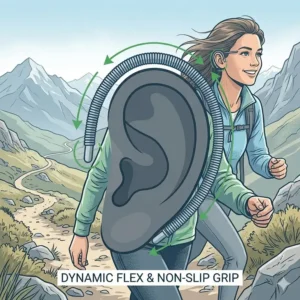
Choosing cable temple eyeglass frames is a departure from standard eyewear. To help you decide, we’ve developed this “priority checklist” based on real-world use cases.
1. The “Nose Bridge” Test
Does your nose have a low bridge or a very narrow profile? Standard glasses rely heavily on the nose for friction. If your nose doesn’t provide that “shelf,” cable temples are your best friend. Because they anchor behind the ear, the bridge fit becomes secondary to the ear fit.
2. The Activity Level Assessment
-
Sedentary (Office/Reading): You might find cable temples “overkill” and potentially uncomfortable for 8-hour wear.
-
Moderate (Walking/Commuting): Excellent for security during sudden movements.
-
High (Cycling/Construction): Essential. If you are sweating or looking down frequently, cables are the only way to ensure your lenses stay in the “sweet spot” of your vision.
3. The Prescription Weight Factor
If you have a high “minus” or “plus” prescription, your lenses are likely heavy. Even with high-index plastics, a thick lens pulls the center of gravity forward. Cable temples act as a counter-balance. By hooking behind the ear, they “pull” the frame back, preventing that annoying slide. If your current glasses leave red marks on your nose, switching to a cable style can actually alleviate that pressure by transferring some of the load to the back of the ears.

Maintenance Guide: How to Adjust Cable Temples Without Breaking Them
Buying cable temple eyeglass frames is only half the battle; the “transformation” happens when you fit them to your unique ear shape. Most people assume the “curl” is fixed, but high-quality cables are designed to be manipulated.
The “Warm Water” Trick
If your cables are acetate-covered (like the Ray-Bans), do not try to bend them cold. The plastic can “bloom” or crack. Instead, run the temple under warm (not boiling) tap water for 30 seconds. This softens the material, allowing you to tighten or loosen the hook. If the hook is too tight and “pinching” the back of your earlobe, gently straighten the very end of the cable.
Symmetry is a Myth
Human ears are rarely perfectly symmetrical. One might be slightly higher or further back than the other. With cable temple eyeglass frames, you can adjust each side independently. If your glasses sit crooked on your face, it’s often because one cable is pulling tighter than the other. Use a mirror to see where the cable makes contact. Ideally, the cable should follow the curve of your ear without pressing firmly against the “root” where the ear meets the skull.
Cleaning the Coils
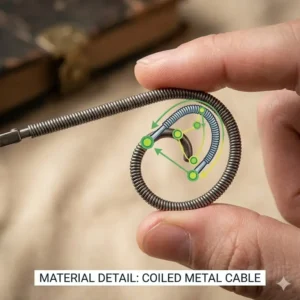
Traditional metal cables are made of tiny interlocking wires. Over time, skin oils and sweat can get trapped in these gaps. Use an ultrasonic cleaner once a month, or a soft-bristled toothbrush with a drop of dish soap. If you neglect this, the metal can corrode or develop “green” oxidation (verdigris), which can irritate your skin.
How to Choose the Right Cable Length
One of the biggest mistakes in selecting cable temple eyeglass frames is ignoring the “overall temple length” (OTL). On a standard pair of glasses, a 140mm or 145mm temple is common. However, cable temples are measured differently because they have to travel all the way around the ear.
-
For Kids: Look for 110mm to 125mm.
-
For Small/Average Adults: 145mm to 155mm is standard.
-
For Large Heads: You must seek out 165mm to 170mm cables.
If the cable is too short, the “hook” will sit on top of your ear instead of behind it, which is incredibly painful. If it’s too long, the glasses will slide forward before the hook even engages. When measuring, use a piece of string to trace the path from your frame hinge, over the ear, and down to the bottom of the lobe. Straighten the string and measure it against a ruler—that is your ideal OTL.

Cable Temples vs. Standard Temples: The Real-World Performance Gap
While standard “skull” temples are easier to put on and take off with one hand, they fail in “pitch and roll” scenarios. Imagine you are a photographer looking through a viewfinder. Every time you tilt your head, gravity tries to pull your glasses off. Standard temples rely on “lateral pressure” (squeezing your head) to stay on.
In contrast, cable temple eyeglass frames rely on “mechanical lock.” They don’t need to squeeze your temples to stay put. This is a massive benefit for people who suffer from tension headaches. By removing the “squeeze” and replacing it with a “hook,” you can actually wear a looser-fitting frame that stays more secure than a tight standard frame. In my years of testing, I’ve found that for anyone wearing their glasses for more than 12 hours a day, the “mechanical lock” of a cable is far more comfortable than the “friction grip” of a standard temple.
The Resurgence of Vintage Aesthetics in 2026
Fashion is cyclical, but in 2026, we are seeing a massive “Neo-Vintage” movement. Cable temple eyeglass frames are at the center of this trend. Young professionals are moving away from the “disposable” plastic look of the 2010s and toward “Buy It For Life” (BIFL) products.
Brands like Shuron and Savile Row are seeing a surge in popularity among Gen Z and Millennials who value the “Steampunk” and “Dark Academia” aesthetics. However, unlike the original 1920s frames, today’s versions are being paired with blue-light filtering lenses and transition coatings. This blend of “Old World” security and “New World” lens technology represents the peak of modern eyewear utility. The “curl” isn’t just a functional choice anymore—it’s a style statement that says you value craftsmanship over mass production.
Long-Term Cost & Maintenance of Cable Frames
When considering the price of cable temple eyeglass frames, you have to look at the “Cost Per Wear.” A $20 pair of “gas station” readers might last two months. A high-quality pair of Savile Row or Shuron frames, if maintained, can literally last 20 to 30 years.
The cables themselves are the only “moving part” that might eventually need replacement. On most high-end frames, the cables are “plug-in” or “screw-in,” meaning if the metal eventually fatigues and snaps (usually after 5-10 years of daily bending), you can order replacement temples for around $40-$60 rather than buying a whole new frame. This modularity makes them one of the most sustainable choices in the optical industry.
Common Mistakes When Buying Cable Temples
-
Mistake 1: Ordering Without “Bridge” Consideration. People get so excited about the cables they forget that the bridge (the part on the nose) still needs to fit. If the bridge is too wide, the cables will be under constant “pulling” tension, which will eventually hurt your ears.
-
Mistake 2: Using One Hand to Remove Glasses. You cannot easily whip cable temples off with one hand like you do with standard glasses. If you try, you will bend the frames out of alignment or potentially hurt your ear. These require a two-handed “unhooking” motion.
-
Mistake 3: Ignoring the “Nikel Factor.” Many vintage-style cables use nickel-silver cores. If you have a severe nickel allergy, you must look for titanium cables or those with full acetate sleeves (like the Ray-Bans).
Features That Actually Matter (And Those That Don’t)
When browsing Amazon or optical shops, marketers will throw a lot of “specs” at you. Here is what actually matters for your comfort:
-
Core Material: Look for “Monel” or “Titanium.” These offer the best balance of flex and strength. Avoid “mystery metal” or “pot metal” which will snap after three bends.
-
Cable Gauge: A thinner cable is more “discreet” but can feel “sharper” on the ear. A thicker cable (like the Shuron Relaxo) is more comfortable for heavy frames.
-
Tip Protection: Does the end of the cable have a smooth “ball tip”? If it’s just a raw wire end, it will scratch you every time you put them on.
What doesn’t matter as much is “Brand Name” versus “Optical Heritage.” There are many “designer” brands that slap a cable on a frame for style, but they don’t understand the tension physics. Stick to brands with a history in “riding temples” or “military frames.”
✨ Don’t Miss These Exclusive Deals!
🔍 Take your vision to the next level with these carefully selected products. Click on any highlighted item to check current pricing and availability. These tools will help you create authentic results your family will love!
Conclusion
Cable temple eyeglass frames are the ultimate fusion of form and function. Whether you’re an athlete, a parent of a rambunctious toddler, or a vintage style aficionado, the security offered by a “riding temple” is unparalleled. In a world where we are constantly on the move, having eyewear that moves with us—rather than sliding off us—is a small but significant lifestyle upgrade. From the high-end luxury of Savile Row to the rugged utility of Uvex, there is a cable frame for every face and every budget in 2026. Stop pushing your glasses up and start enjoying the “locked-in” comfort of the world’s most secure temple design.
FAQs
❓ Are cable temple eyeglass frames uncomfortable to wear with headphones?
✅ It depends on the headphone style. For over-ear headphones, thin metal cable temples are actually more comfortable than thick acetate ones because they don’t break the “seal” of the ear cushion. However, very tight headphones can press the cable into your skin…
❓ Can I turn my current glasses into cable temple eyeglass frames?
✅ Yes, for many frames! You can purchase “cable converters” or “temple tips” that slide onto your existing standard temples. While not as seamless as a dedicated frame, these silicone “ear hooks” provide a similar level of security for sports…
❓ Do cable temples cause soreness behind the ears?
✅ Initially, yes. There is a 3–5 day “break-in” period where your skin gets used to the contact. If soreness persists, it means the “curl” is too tight or the temple length is too short. A minor adjustment usually fixes this…
❓ Are these suitable for people who wear hearing aids?
✅ This is tricky. Since both the cable and the hearing aid need to occupy the space behind the ear, it can get “crowded.” I recommend ultra-thin titanium cables if you wear BTE (Behind The Ear) hearing aids to minimize bulk…
❓ How do I know if my cable temples are too long?
✅ If you look in the mirror and there is a visible gap between the “crook” of your ear and the curve of the metal, they are too long. The cable should make light contact with the entire back of the ear…
Recommended for You
- 5 Best cable temple eyeglasses for Maximum Comfort in 2026
- Cable Temple Glasses Guide: 7 Best Frames for a Secure Fit in 2026
- Anti Slip for Eyeglasses: 7 Proven Solutions That Work Perfectly [2025]
Disclaimer: This article contains affiliate links. As an Amazon Associate, I earn from qualifying purchases. If you purchase products through these links, we may earn a small commission at no additional cost to you.
✨ Found this helpful? Share it with your friends! 💬🤗
[addtoany]
